Descripción
Don’t just use conversational AI. Design it well.
The Curso de IA conversacional para productos digitales is an applied,
product-focused learning experience for people who want to understand how AI
conversations actually work inside modern digital products.
Across six modules, you’ll move from product framing and conversation behavior
into prompts, context, grounding, tools, actions, trust, safety, privacy,
evaluation, monitoring, governance, and launch readiness.
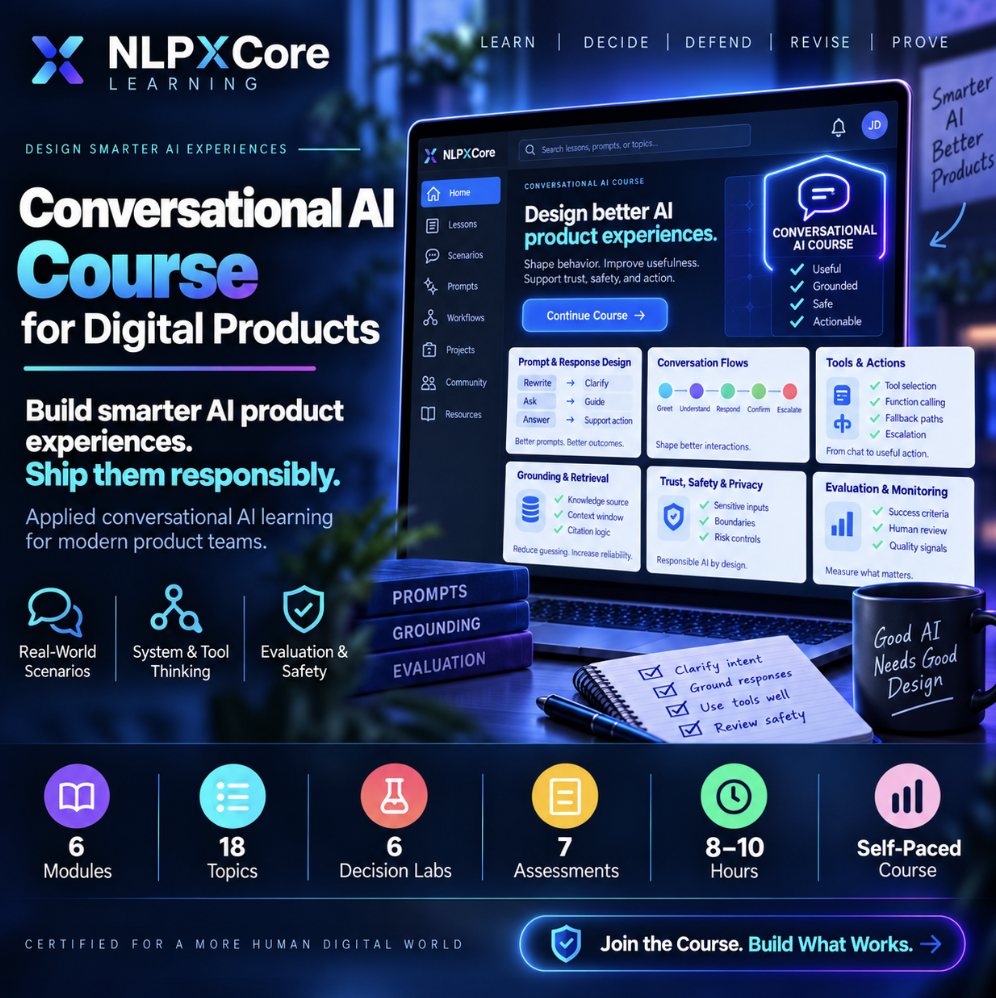
18 Topics
6 Decision Labs
7 Assessments
8–10 Hours
Self-Paced
80% Decision Lab Mastery
Build AI experiences that are useful, grounded, and responsible
Conversational AI is more than writing prompts or adding a chatbot to a product.
Strong AI experiences require decisions about user intent, product goals,
conversation flow, memory, context, retrieval, tool use, escalation,
uncertainty, safety, privacy, and evaluation.
This course teaches those systems together so you can reason about the complete
experience instead of treating each response as an isolated block of text.
- Frame conversational AI around real user tasks and product outcomes.
- Design interaction flows, context, turns, and response behavior.
- Use grounding and retrieval to improve reliability and reduce unsupported answers.
- Understand when AI should use tools, functions, or external systems.
- Design fallbacks, uncertainty handling, escalation, and recovery.
- Account for trust, safety, privacy, accessibility, and sensitive inputs.
- Evaluate AI quality with practical criteria instead of vague impressions.
- Plan monitoring, governance, iteration, and responsible product launch.
Six modules built around real AI product decisions
Frame the AI Product
Define the user need, product goal, interaction model, AI boundaries,
success criteria, risks, and where conversational AI adds genuine value.
Design Conversation Behavior
Structure intents, turns, context, memory, response behavior,
clarification, and state across realistic product interactions.
Ground Responses & Use Tools
Understand retrieval, source grounding, context windows, tool selection,
function calling, external actions, and reliability tradeoffs.
Design for Trust & Safety
Handle uncertainty, failure, sensitive information, user expectations,
privacy, accessibility, boundaries, and escalation responsibly.
Evaluate & Improve Quality
Define success criteria, evaluate outputs, test edge cases,
use human review, monitor quality signals, and prioritize improvements.
Ship & Govern the Experience
Bring product strategy, evaluation, operations, stakeholder review,
governance, launch planning, and portfolio proof together.
Every module ends with a Decision Lab.
Conversational AI involves tradeoffs. A design that sounds good can still fail
because it uses the wrong context, weak grounding, unsafe behavior, poor recovery,
or the wrong tool.
Each NLPXCore Decision Lab gives you a realistic AI-product
scenario. You make the decision, explain your rationale, receive immediate
rubric-based coaching, respond to a simulated stakeholder challenge, and revise
until you demonstrate mastery.
Choose the strongest product, interaction, grounding, tool, or safety approach.
Explain the reasoning, evidence, tradeoffs, limitations, and user impact.
Respond to feedback and strengthen the experience until it meets mastery.
Your strongest mastered submissions become part of your personal
Conversational AI Decision Portfolio.
Practice the systems behind modern conversational AI
Prompt & Response Design
Clarification, response structure, useful action, role boundaries,
instruction design, and behavior guidance.
Conversation Flows
Intents, turns, states, branching, memory, context, confirmation,
repair, fallback, and escalation.
Grounding & Retrieval
Knowledge sources, retrieval strategy, context selection,
evidence handling, citations, and uncertainty.
Tools & Actions
Tool selection, function calling, external systems, action confirmation,
execution boundaries, and fallback paths.
Trust, Safety & Privacy
Sensitive information, harmful outcomes, product boundaries,
user expectations, escalation, accessibility, and privacy.
Evaluation & Monitoring
Success criteria, quality rubrics, human review, failure analysis,
regression testing, monitoring, and iterative improvement.
How this differs from other NLPXCore AI learning
Learn the complete AI product system.
Understand and practice how conversational AI products are framed,
designed, grounded, evaluated, governed, and improved.
Build shared team capability.
Practical training designed around repeatable team methods,
shared language, and applied AI-product workflows.
Design the interaction itself.
Focus more deeply on conversation architecture, dialogue,
turn-taking, repair, language behavior, modality, and flow design.
Who this course is for
- Product designers working on AI-powered interfaces or assistants.
- UX writers and content designers expanding into conversational AI.
- Conversation designers working with generative AI systems.
- Product managers responsible for AI features and user outcomes.
- Developers and technical practitioners who want stronger product-design judgment around AI interactions.
- Researchers, strategists, and cross-functional team members evaluating AI experience quality.
Learn AI product design without pretending the system is magic
This course treats conversational AI as a product system with capabilities,
limitations, uncertainty, dependencies, and tradeoffs.
NLPXCore uses AI as an interactive learning and practice tool, but the course
does not invent user research, analytics, legal requirements, safety guarantees,
company outcomes, or universal best practices. Strong AI product work still
requires human judgment, evidence, review, and accountability.
Build smarter AI experiences. Ship them responsibly.
Learn how to move from prompts and responses to complete conversational AI
product experiences that are useful, grounded, safe, measurable, and ready
for real-world product decisions.