Description
Don’t just create a strategy. Build a content practice that scales.
Content Strategy Training for Digital Products is practical,
applied professional training for people and teams who need repeatable methods
for understanding content problems, setting priorities, designing systems,
establishing governance, measuring results, and aligning stakeholders.
Across six modules, you’ll develop the operating habits behind sustainable
content strategy—from current-state diagnosis and structured content to
governance, measurement, prioritization, roadmaps, and rollout.
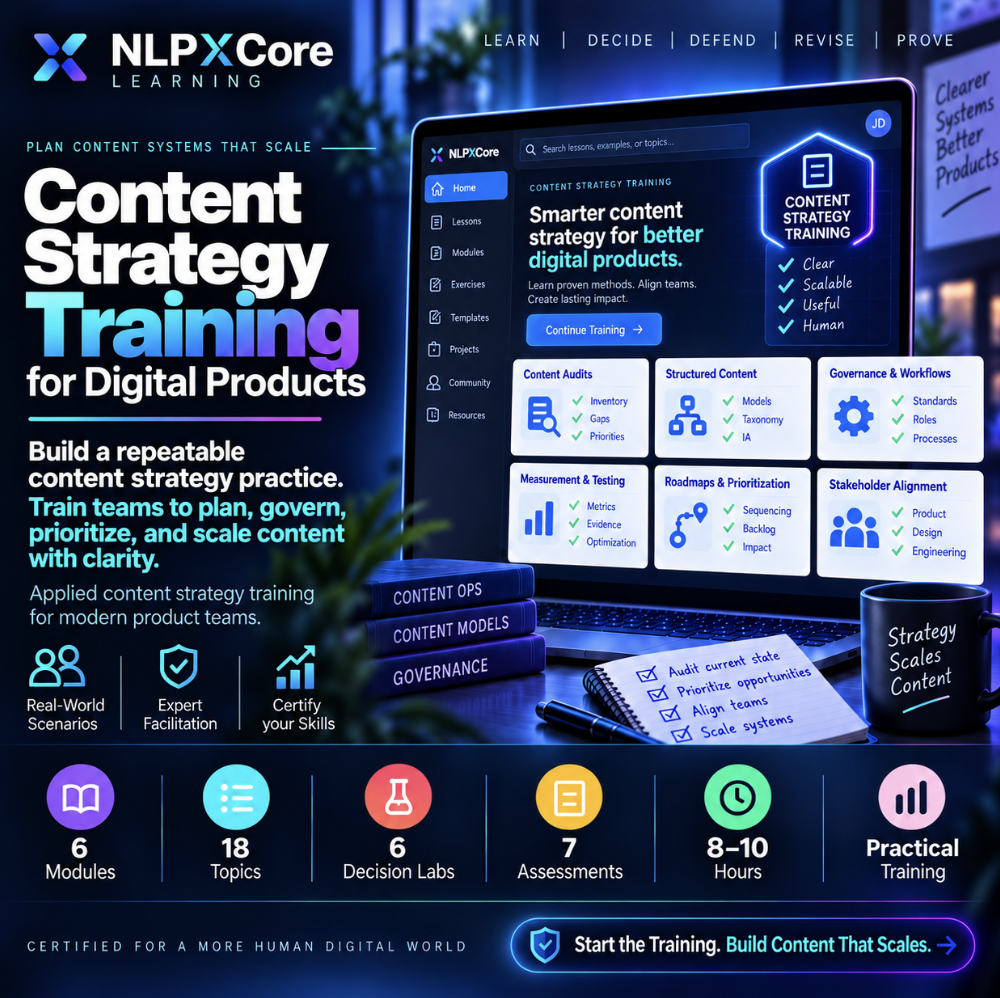
18 Topics
6 Decision Labs
7 Assessments
8–10 Hours
Self-Paced
80% Decision Lab Mastery
Turn content strategy into a repeatable operating practice
Content strategy becomes valuable when it changes how teams make decisions,
not when it ends as a presentation no one uses.
This training focuses on the systems and methods that help organizations
understand their current content, prioritize opportunities, structure content
for reuse, define ownership, establish workflows, measure performance, and
coordinate meaningful change across teams.
- Frame content problems around user needs, product outcomes, and organizational constraints.
- Run inventories, audits, gap analysis, and current-state diagnosis.
- Design content models, taxonomy, information architecture, and structured-content systems.
- Define governance, standards, workflows, ownership, and decision rights.
- Build measurement approaches that connect evidence to strategy decisions.
- Prioritize opportunities and translate strategy into practical roadmaps.
- Align stakeholders and create rollout practices that teams can actually sustain.
Six modules for building scalable content strategy practice
Strategic Framing & Alignment
Connect user needs, product outcomes, organizational goals,
evidence, constraints, stakeholders, and decision criteria before
choosing solutions.
Audits & Current-State Diagnosis
Build content inventories, identify gaps and duplication,
assess quality and risk, map opportunities, and create evidence
for prioritization.
Structured Content & Systems
Work with content models, taxonomy, metadata, information architecture,
reusable structures, lifecycle needs, and systems that support scale.
Governance & Operations
Define standards, roles, ownership, workflows, review models,
decision rights, maintenance practices, and governance that teams
can realistically operate.
Measurement & Prioritization
Select useful evidence, establish success criteria, interpret signals,
evaluate tradeoffs, prioritize work, and connect measurement to
strategic decisions.
Roadmaps, Rollout & Team Practice
Turn strategic recommendations into sequenced roadmaps,
stakeholder alignment, handoff, adoption, governance,
and sustainable operating practice.
Every module ends with a Decision Lab.
Content strategy involves judgment under imperfect conditions. There may be
competing priorities, limited evidence, unclear ownership, technical
constraints, stakeholder pressure, or multiple defensible options.
Each NLPXCore Decision Lab places you inside one of those
situations. You make the strategic decision, create an artifact or recommendation,
explain the rationale, receive immediate rubric-based coaching, respond to a
simulated stakeholder challenge, and revise until you demonstrate mastery.
Choose a strategy, prioritization, governance, measurement, or rollout approach.
Explain the evidence, tradeoffs, user impact, business value, and operating implications.
Respond to stakeholder pressure and strengthen the strategy until it meets mastery.
Your strongest mastered work is retained in your personal
Content Strategy Decision Portfolio.
Practice the systems behind effective content strategy
Content Audits
Inventories, quality assessment, gaps, duplication,
risk, current-state analysis, and opportunity identification.
Structured Content
Content models, taxonomy, metadata, information architecture,
reusable components, and scalable content structures.
Governance & Workflows
Roles, ownership, standards, review processes, approval models,
decision rights, maintenance, and lifecycle responsibility.
Measurement & Testing
Success criteria, evidence, analytics, qualitative research,
testing, interpretation, and defensible optimization decisions.
Roadmaps & Prioritization
Opportunity scoring, sequencing, backlog decisions, dependencies,
effort and impact tradeoffs, and strategic roadmaps.
Stakeholder Alignment
Product, design, engineering, research, operations,
leadership, governance partners, and cross-functional decision making.
How Content Strategy Training fits into NLPXCore
Learn the discipline.
Build broad practitioner understanding of content strategy,
systems, governance, evidence, and strategic decision making.
Build repeatable team practice.
Develop methods, operating habits, governance, prioritization,
measurement, collaboration, and rollout practices teams can reuse.
Build the strategy package.
Work intensively through one coherent strategic problem and
develop an applied Content Strategy Workshop Portfolio.
Who this training is for
- Content strategists who want stronger repeatable professional methods.
- Content designers moving into broader strategic and systems work.
- UX and product teams responsible for content at scale.
- Content operations professionals building governance and workflow systems.
- Product managers and design leaders responsible for cross-functional content decisions.
- Organizations developing a more mature and sustainable content practice.
Use AI to strengthen the work—not replace strategy
NLPXCore uses AI where it adds learner value: source-supported research,
structured practice, simulated stakeholder challenges, immediate feedback,
and revision coaching.
The training does not treat AI output as user research, analytics,
company policy, legal requirements, or strategic truth. Strong content
strategy still depends on evidence, organizational context, thoughtful
prioritization, human judgment, and accountable decision making.
Plan clearly. Govern deliberately. Build content systems that scale.
Content Strategy Training for Digital Products helps turn strategic
thinking into repeatable methods, stronger governance, clearer priorities,
better stakeholder alignment, and sustainable content operations.